You need a tape that won't fail, but the options are overwhelming. Choosing the wrong one can lead to costly problems. I'll help you find the perfect tape for your job.
There is no single "strongest" tape. The best tape is the one that is most suitable for your specific application. It should provide the best bonding performance1 and the highest cost-effectiveness2 for your unique project, materials, and environment.
In my 10 years in the tape industry, "What is the strongest tape3?" is the question I hear most often. Everyone wants a simple answer, a single product that solves all their problems. But the truth is, the world of adhesives is far more complex and interesting than that. The real goal isn't to find the "strongest" tape, but the "right" tape. A tape that fails on one project might be the perfect solution for another. Let's explore why this is and how you can make the right choice every time.
Is the most technically advanced tape always the best choice?
It’s tempting to think the most expensive, high-tech tape is the best. But this can be a costly mistake if it’s not right for your job. Let's look at why.
Not always. A high-tech tape like 3M VHB4 is incredibly strong, but its thickness and cost can make it unsuitable for many applications. The best choice depends on your specific needs, not just the technical specifications on a datasheet.
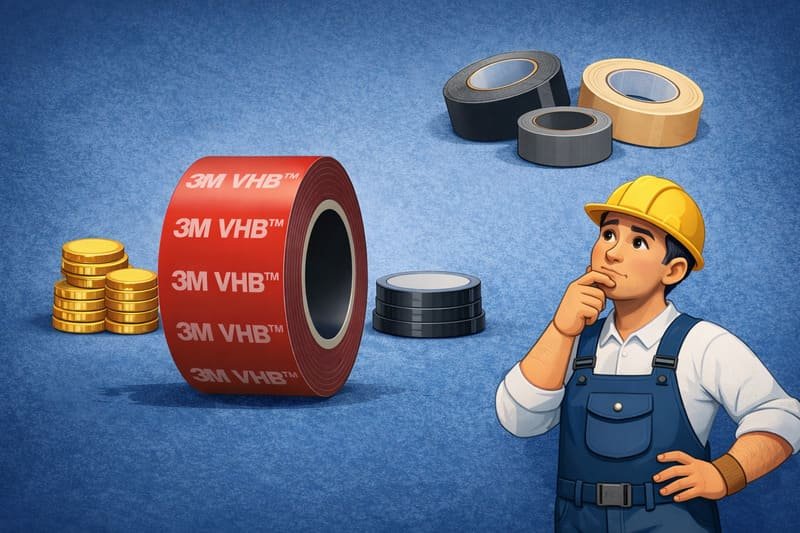
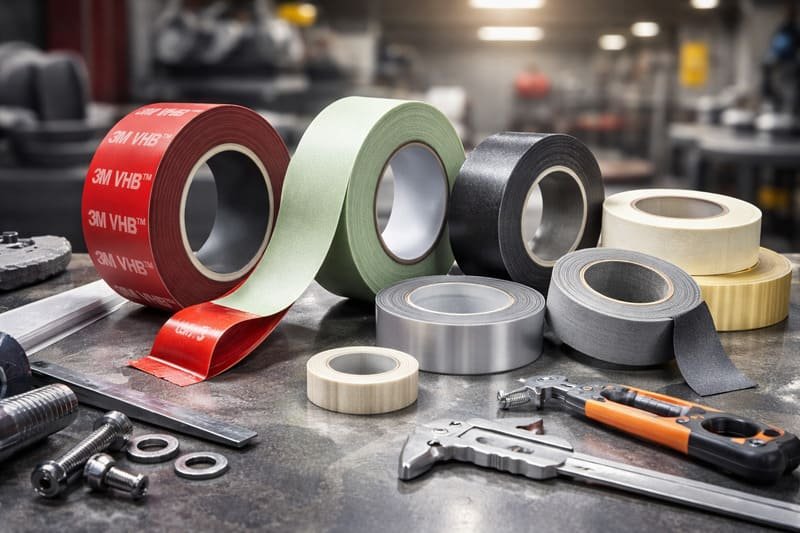
Let's take 3M VHB4 tape as an example. In the world of general industrial tapes, VHB is a legend. Its technology is so advanced that, in my opinion, no manufacturer in mainland China has been able to fully replicate its performance. The best alternatives are still at least 20% weaker. So, if someone tells you their tape is a perfect match for 3M VHB4, you should be skeptical. Because of its incredible strength, especially on low surface energy materials like painted metals, it's the undisputed champion in many automotive and construction applications. But does that make it the "best"? Not for every job. For instance, I work with many home appliance manufacturers. They often need to bond thin membrane switches to control panels. These applications require a tape with a thickness of around 0.1mm to 0.2mm. VHB tapes are much thicker and simply don't have products in this range. For that specific job, VHB is not the best tape. A much less expensive PET double-sided tape5 is the perfect, and therefore "best," solution.
| Tape Type | Best For | Not Suitable For |
|---|---|---|
| 3M VHB4 Tape | Bonding low surface energy surfaces, automotive trim | Thin applications (e.g., membrane switches) |
| PET Double-Sided Tape | Thin, precise applications, electronics | Heavy-duty structural bonding |
| Non-Woven Tape | General purpose mounting, foam lamination | High-stress or high-temperature applications |
How do tape properties create a performance trade-off?
You want a tape with high initial stick and great long-term strength. But you might find that tapes that excel in one area are weak in another. You need to understand the trade-offs.
Improving one tape property, like initial tack6, often comes at the cost of another, like holding power7. It's a balancing act. You can't have an adhesive that is both extremely "soft" for quick stick and "hard" for long-term hold.
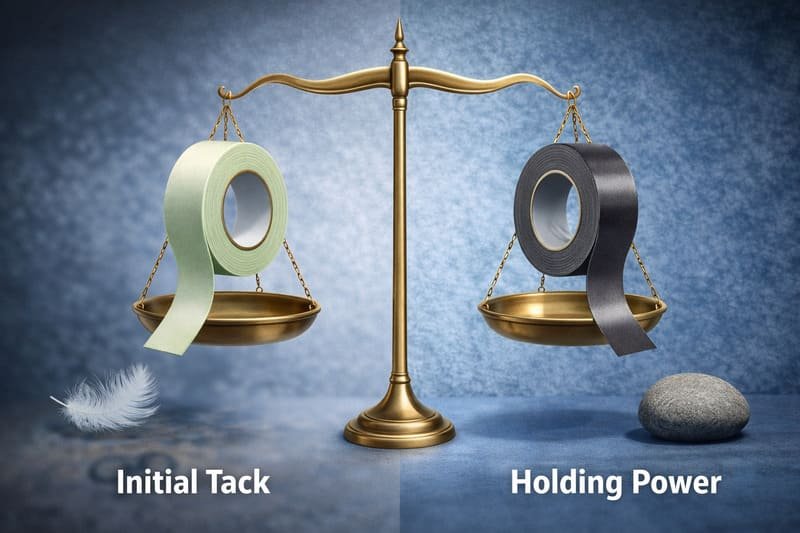
Things are rarely perfect, and adhesive tape performance8 is no exception. When we develop a tape, we are constantly balancing four key properties: initial tack6, ultimate adhesion, holding power7 (shear), and conformability9. Improving one often means sacrificing another. For example, I have a Sekisui A-550010 tape in my portfolio. Its initial tack6 is amazing. It can bond to PU foam in the cold winter workshops of northern China where other tapes fail. But its long-term holding power7 and its ability to conform to curved surfaces are not very good. When I explain this to clients, I describe the adhesive as being very "soft." A soft adhesive flows quickly and wets out a surface, creating a fast bond. This is because its molecules have high thermal motion activity, allowing them to quickly entangle with the molecules of the surface it's sticking to. But because it's soft, it can't resist the constant pull of gravity or stress as well as a "hard" adhesive. You can't get a tape that is both very soft and very hard at the same time. This is why many tape models on the market were originally developed for one specific project with a unique set of demands. It might have been the "best" tape for that project, but it might not be the best for yours.
| Performance Goal | Consequence of Maximizing |
|---|---|
| Highest Initial Tack | May reduce long-term holding power and heat resistance. |
| Highest Holding Power | May reduce initial tack and ability to stick to curved surfaces. |
| Highest Conformability | Adhesive may be too soft, leading to lower shear strength. |
Do temperature and pressure really make that much difference?
Your tape is failing even though it seems to be the right type. You could be wasting money because of simple, and common, application errors. Let's look at two critical factors.
Absolutely. Application temperature and the pressure you apply are critical. Using tape in the cold or without enough pressure can slash its bonding strength by over 50%, causing failures even with the perfect tape.
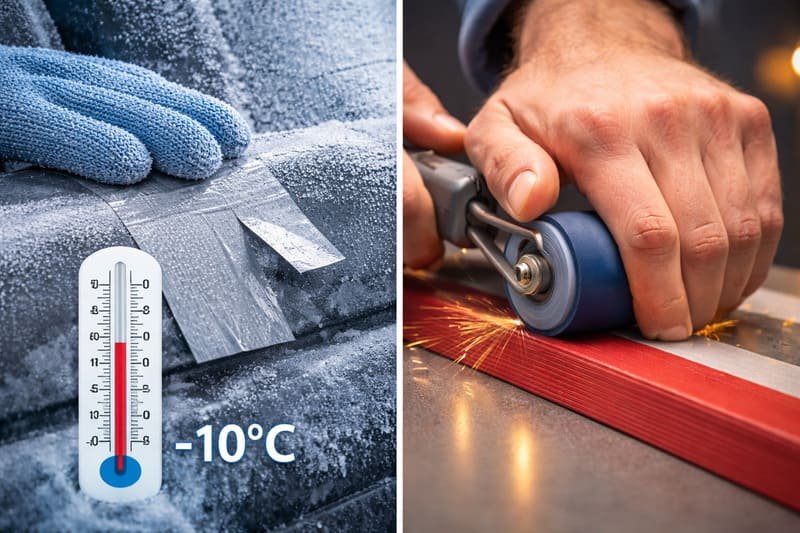
The datasheet for a tape only tells half the story. How you use it is just as important as what you use. Two of the most overlooked factors are temperature and pressure11. Let's break them down. First, temperature. We need to think about the "operating temperature," which is the temperature of the air, the tape itself, and the surface you're bonding to during application. Most industrial acrylic tapes have a recommended application range of 15°C to 30°C. I once had a client in Hefei who made membrane switches for Midea rice cookers. They called me because the tapes were failing in winter. When I visited their factory, I saw that the workshops were open and unheated. The temperature was about 5°C. At that temperature, the adhesive was too hard to flow and create a proper bond. We suggested they add infrared heaters at each workstation and use a heat gun to warm the plastic parts right before applying the tape. It wasn't a perfect fix, but it solved the problem. Second is pressure. After you apply an acrylic pressure-sensitive adhesive12, it needs firm, sustained pressure to work properly. This pressure forces the adhesive into the microscopic hills and valleys of the surface, maximizing contact and building a powerful bond. In our lab, we've seen that a bond made with proper pressure can be over 50% stronger than one made without. Many times, a client will say a tape doesn't stick. But when we test the exact same materials in our lab with proper application methods, the bond is so strong it's permanent.
Conclusion
There is no "best" tape, only the most "suitable" one. To find it, consult a professional and provide details about your project to get the perfect recommendation.
Understand the importance of bonding performance in choosing the right tape for your application. ↩
Explore how to evaluate the cost-effectiveness of different tapes for your specific needs. ↩
Discover the top options for strong tape that can meet your specific needs and avoid costly mistakes. ↩
Learn about the unique properties of 3M VHB tape and whether it's the right choice for your project. ↩
Discover the advantages of PET double-sided tape for thin and precise applications. ↩
Find out how initial tack impacts the performance of adhesive tapes in various applications. ↩
Learn about holding power and its significance in ensuring a strong bond with adhesive tapes. ↩
Explore the various factors that can affect the performance of adhesive tapes in real-world applications. ↩
Discover why conformability is crucial for achieving effective adhesion on uneven surfaces. ↩
Learn about the unique properties of Sekisui A-5500 tape and its ideal applications. ↩
Learn about the critical role of temperature and pressure in achieving strong tape bonds. ↩
Explore the mechanics of pressure-sensitive adhesives and their role in tape performance. ↩